 My Favourites


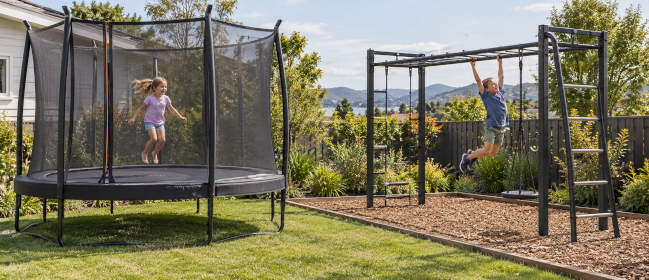
Buy the trampoline and monkey bars that fit your yard and your kids in three years’ time, and they’ll get used until high school.
I put off buying a trampoline for years. Partly I remembered the bruised shins of my own childhood (the old ones had bare springs and no net), and partly I couldn’t picture where on earth it would go. When we finally bought one, getting the tape measure out first saved us from an expensive mistake.
Get the tape measure out
Trampolines are sold by diameter, but the space you need is a lot bigger than the mat. Allow roughly two metres of clear ground on every side, so a kid who bounces off-centre lands on grass instead of the fence or the deck steps. Look up as well. Washing lines and overhanging branches need to be well out of reach of a bouncing eight-year-old.
Flat ground matters too, and plenty of Kiwi sections are anything but. If your lawn slopes, you’ll need to dig the high side down or look at an in-ground trampoline, which sits at lawn level and takes the height out of any fall. In-ground setups cost more once you add digging and drainage, so get a quote before you fall in love with the idea.
Monkey bars need a different footprint: long and narrow, with room at each end to climb off and space either side for swinging legs. Lawn is fine to start with, but by February the grass under the bars is usually worn to hard clay. A deep layer of bark or playground mulch is much kinder to land on. Keep them well away from concrete paths.
Then there’s the wind. Anyone who’s lived through a Canterbury nor’wester or a Wellington southerly knows a trampoline can take off, and there’s a reason flying trampolines turn up in the local news. Budget for an anchor kit with whatever you buy.
Which piece suits which stage
Under three or so, a full-size trampoline is more risk than fun. Toddlers get flung about by bigger bouncers and can’t control their landings yet. A mini trampoline with a handlebar on the deck burns off the same energy, and most full-size trampolines carry a minimum age on the label, so check it before you buy.
Monkey bars are a different story at this age. A toddler won’t swing across, but they’ll happily climb the ladder ends and hang for a few seconds over soft ground, which is exactly the grip-strength practice they’ll need later. Sets with adjustable height or add-ons like a swing or slide earn their keep here, because the bars themselves won’t see much action for a year or two.
From about four or five, most kids are ready for a netted trampoline with an adult nearby, and they start working across the monkey bars one rung at a time. Mine took most of a summer to get from one end to the other, with plenty of blisters along the way!
School-age kids push equipment harder. They’ll double-bounce their siblings and try flips they’ve seen online. A bigger trampoline and a sturdier frame pay off here, and the cheapest option bought for a four-year-old can wobble its way to the tip a few years later. If you only have the budget or space for one piece, buy for the kids you’ll have in three years’ time.
What to check before you buy
Start with the design. Look for an enclosure net that attaches inside the springs, or a springless design, so there’s no gap where a foot can slip through onto the frame. The padding should cover the springs and frame completely, with no gaps at the joins. On monkey bars, check that the rungs suit small hands and that the frame can be pegged or anchored into the ground, because a set that rocks when your kid swings is a set that can tip.
Whichever brand you’re eyeing up, ask which safety standard it’s tested to and whether replacement nets and pads are sold separately, since those parts take the brunt of our UV. Vuly Play, an Australian company that now sells to Kiwi families, is one example. Its safety page lists AS4989:2015 and EN 71-14:2018 for trampolines and the AS/NZS ISO 8124 toy safety series for monkey bars. The company also tests products in its own lab in Brisbane. If you’d like to compare, the New Zealand range of Vuly’s trampolines and monkey bars is on one site, so you can check sizes against your yard before you commit. Put the same questions to every other brand on your shortlist, second-hand Trade Me finds included.
Second-hand can save you a fair bit, but go and look in person. Check for rust where the legs join the frame and for stretched or missing springs. Pull a section of the net between your hands, and if it feels brittle or chalky, it’s had too much sun. Get the brand and model name from the seller, then make sure you can still buy parts for it before you hand over any cash.
Setting it up
Assembly is a two-adult job, and it’s worth doing on a calm, dry day with the instructions laid out on the lawn. (Ask me how I know.) Once it’s up, go back and re-tighten every bolt after the first few weeks, because frames settle as they’re used. Then do a proper check each spring before the kids get back on after winter: net, pad, springs and anchors.
Move the trampoline every few months if you can. Leave it in one spot and you’ll end up with a perfect circle of dead lawn, and Grandad will have opinions.
Rules for the bouncers
The rule that matters most is one at a time, especially with mixed ages. A heavier child’s bounce can launch a lighter one straight into the net, or past it. Teach kids to climb off rather than jump off, and take the ladder away when no adult is around, which keeps toddlers and visiting cousins off when you’re not watching.
On the monkey bars, keep it to hands only until they can cross confidently. Knee hangs and sitting on top can come later, once they’ve got the strength to hold on and the sense to come down slowly.
Written by a North Canterbury mum of two whose lawn still has a trampoline-shaped patch she’s not allowed to mention.



Speak Your Mind