 My Favourites

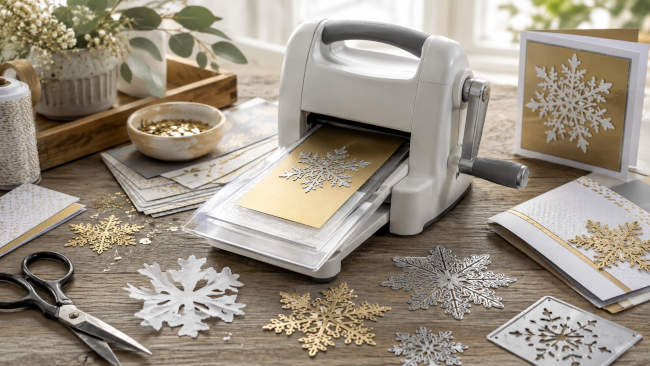
Three Christmases ago, a full sheet of gold foil cardstock got ruined by one crafter trying to hand-cut a snowflake for her niece’s birthday card. Jagged edge. One point snipped clean off. About forty minutes of an afternoon, gone. That was the week the scissors got retired and a die cutter got bought instead.
You’ve probably had a version of that afternoon if you make cards, scrapbook or do paper-based mixed media of any kind. A die cutter (the machine, not the little metal shapes, though people mix up the terms constantly) fixes that exact problem. Cardstock and a die get fed through a hand-cranked or motorized roller system together, and the die presses clean through the paper. No wobble. Same shape, every time.
The machine in question is a basic entry-level manual model, about as no-frills as these get. Combo cutting-and-embossing machines exist too, and texture gets pressed into the paper along with the shape, raised dots or linen patterns or similar. It’s worth the upgrade for anyone doing a lot of stationery work. For those who mostly need clean shapes, it probably isn’t.
Manual or Digital? The Verdict Was Manual
For about eight months, an electronic cutting machine with software-based design control got used instead. It’s genuinely impressive: a design gets resized on a laptop and cut in thirty seconds, no physical die needed. But small annoyances kept piling up. The material sensor occasionally misread cardstock as vinyl. The software update cycle was mildly obnoxious. And it was never fully trusted not to shift mid-cut on anything with fine detail.
The hand-crank machine has never done that. No outlet is required either, which matters more than you’d expect if you like crafting on the porch or bringing projects to a friend’s house. That said, digital wins easily for one-off custom shapes when you don’t want to buy an individual die for each design. That kind of work just doesn’t come up often enough for it to tip the scale.
Why the Switch Isn’t Regretted
Two things sealed it.
The precision is the first. Lace-edge dies, tiny lettering, delicate cutouts of any kind: a die cutter handles all of it without fail, something scissors are never going to manage consistently.
The second is what it opened up. Pop-up card mechanisms, paper flowers, small gift boxes, all of it became possible once the cutting itself stopped eating up so much effort. Once that part is handled, there’s actual bandwidth left for the design.
A Few Things Worth Knowing Upfront
Steel-rule dies are foam-backed with a thick blade, and chipboard, leather, even a few layers of fabric can be cut through with them. Thin metal “wafer” dies are paper-only. Forcing one through anything thicker isn’t recommended. It’ll bend. That lesson got learned the hard way, more than once.
Etched dies are a nice middle step. The outline gets cut and a subtle detail line gets stamped in at the same time. These get used mostly on envelope flaps.
Pressure is the thing nobody explains well upfront. Acrylic plates, die, and paper get sandwiched together, and if it’s too loose the die won’t cut through, while too tight will warp the plates. The fix, nearly every time: one sheet of plain copy paper, added as a shim, before anything thicker gets reached for. Boring advice. It works about 90% of the time anyway.
If a cut isn’t going all the way through, pressure is almost always the culprit, not a dull die. Sometimes it helps to run the sandwich slightly off-center toward the edge of the roller, since pressure isn’t distributed perfectly evenly across the width on cheaper machines.
Acrylic plates should get checked before the die is blamed for fuzzy or torn edges. In this case, the plates had warped after a year of not being rotated, and it took embarrassingly long to connect that to the problem.
Small Things That Make a Real Difference
A rubber embossing mat, if texture instead of a straight cut is the goal. A magnetic sheet, so thin dies stop sliding around mid-feed. A cheap plastic scraper for clearing stuck paper bits out of detailed dies, though a toothpick works too (a few have been broken this way).
Plates should be rotated every time they’re used, flipped periodically, and kept flat and out of the sun. None of this got done for the first year, and the plates show it.
Was It Worth It?
Yes, mostly because the one genuinely frustrating part of paper crafting got taken off the table. Three machines are owned at this point, which isn’t something to be thrilled about (the beginner one leads to the “just one more” one, which leads to the combo one; it’s a slippery slope). But a snowflake hasn’t been hand-cut with scissors since that Christmas, and there’s no plan to start again.




Speak Your Mind