 My Favourites

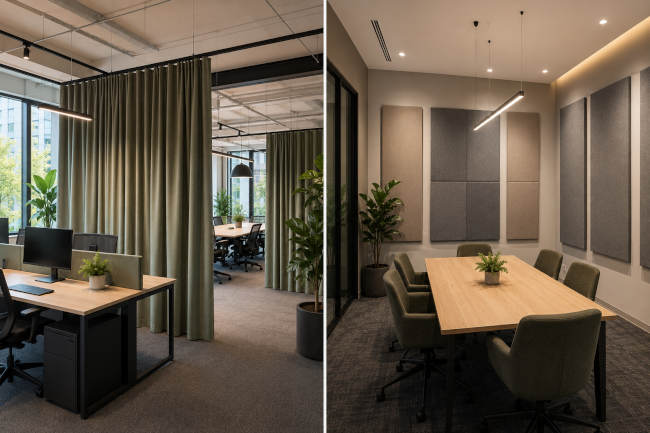
Open offices are loud. You’ve probably sat through a call while a colleague’s conversation bled straight into your focus, or found it nearly impossible to concentrate because every keyboard click bounced off hard walls. The real question isn’t whether you need sound control, it’s which product’ll actually fix the problem.
Both acoustic curtains and acoustic panels work. They just solve slightly different problems. This article breaks down how each performs, where one wins out, and which makes sense for your specific office setup.
How Acoustic Curtains Work in an Office Setting
Office noise can build up quickly, especially in spaces with hard floors, glass walls, high ceilings, or several people working close together. Calls, keyboard sounds, conversations, and movement can make it harder for employees to focus or hold private discussions. This is where noise reducing curtains can help by adding a soft, dense layer that absorbs mid-to-high-frequency sound waves before they bounce around the room. Unlike fixed acoustic panels that stay in one place, curtains can be opened, closed, moved, or used only when the space needs more privacy. They also feel softer and less technical, which makes them a good fit for meeting rooms, shared offices, and open-plan areas where sound control needs to work without making the space feel heavy or closed off.
The Absorption Rate You Should Expect
Acoustic curtains typically achieve a Noise Reduction Coefficient (NRC) between 0.5 and 0.8, depending on fabric weight and how much the curtain gets pleated. More pleating means more fabric surface area; better absorption follows. A lined, triple-pleated curtain on a window wall can realistically cut perceived noise by 40-50% in a medium-sized meeting room.
Where Curtains Outperform Other Options
Curtains pull double duty. They reduce echo and block external noise from traffic, HVAC units, or open windows. In co-working spaces and client-facing offices, they also add a finished, polished look without screaming “industrial sound treatment.” And because they’re on tracks, they’re movable; open them for natural light, and close them before a recorded call.
Installation and Flexibility
Fitting acoustic curtains is straightforward. A standard track system mounts above windows or along any wall; curtains can be rehung in a different room if the space gets reconfigured. Rental offices benefit especially here. There’s no permanent drilling into walls beyond the track brackets.
Acoustic Panels: Targeted Sound Control for Focused Areas
Acoustic panels are rigid boards, usually wrapped in fabric over a mineral wool or foam base, mounted directly to walls or suspended from ceilings. They target specific reflection points, the spots where sound bounces most aggressively and causes echo.
NRC Performance and Frequency Range
High-quality acoustic panels can reach NRC ratings of 0.85 to 1.0, making them more absorptive per square foot than most curtains. They perform especially well at low-to-mid frequencies, where speech muddiness and HVAC drone tend to live. If your main complaint is a “boxy” sound in a conference room, panels placed at first-reflection points on the side walls will solve that faster than curtains can.
Placement Strategy for Offices
Panels work best in fixed layouts, dedicated meeting rooms, recording booths, or enclosed offices where furniture doesn’t move. Acoustic consultants generally recommend covering 15-25% of total wall surface area to hit a balanced reverb time. That’s a relatively small footprint for a big acoustic improvement.
Cost and Commitment
Panels are a longer-term investment. They mount with wall anchors and aren’t easy to relocate without leaving marks. Standard commercial panels run $30-$150 per square foot installed, depending on size, fabric, and NRC rating. Budget-friendly foam tiles exist, but in practice they don’t match fabric-wrapped mineral wool boards in a professional setting; their performance and durability fall short.
Acoustic Curtains vs Acoustic Panels: Which Is Better for Office Space?
The answer depends on what your office actually needs. Neither option is universally superior. They solve different acoustic problems at different price points and commitment levels.
Matching the Product to the Problem
Use acoustic curtains if your office has large glass surfaces, gets external noise intrusion, or needs flexibility. Use acoustic panels if you have a fixed meeting room with a persistent echo problem and want the highest possible NRC per square foot. Many well-designed offices use both.
Budget and Practicality
Acoustic curtains generally cost less upfront and are simpler to install. A set of heavy commercial-grade curtains for a standard meeting room typically runs $500-$1,500 including tracks, depending on the supplier and size. Panels cost more per unit but require fewer square feet of coverage to hit the same acoustic target; the total cost difference narrows in smaller rooms.
The Right Choice for Most Offices
For open-plan offices, hot-desking environments, or any space that changes frequently, curtains are the more practical pick. For dedicated conference rooms or private offices where you need speech clarity above everything else, panels deliver a cleaner result. Here’s the thing: which is better comes down to your layout, your budget, and how permanent the fix needs to be.
Conclusion
Acoustic curtains and acoustic panels both reduce noise, but they’re designed for different scenarios. Curtains cover large surface areas fast, add visual warmth, and stay flexible as your office layout shifts; panels hit higher NRC ratings and target specific reflection problems in fixed rooms. Most offices benefit from a mix. Start with the loudest problem in your space, match the product to that specific issue, and you’ll get results faster than any one-size-fits-all approach would deliver.





Speak Your Mind