 My Favourites


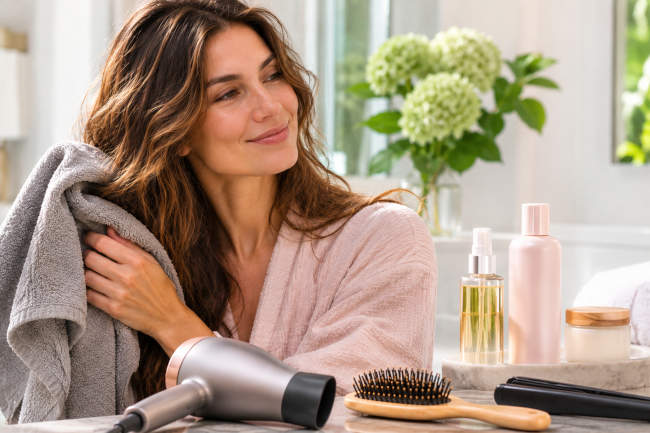
Hair rarely turns dry, brittle, or breakage-prone overnight. More often, it’s the slow accumulation of small daily habits – how hair gets washed, dried, brushed, and styled – that gradually wears down its structure. Repeated heat exposure, friction from towels and brushes, chemical processing, and tight hairstyles can all chip away at hair’s condition over time.
The encouraging part is that healthier styling doesn’t require giving up every tool or treatment; it’s really about cutting unnecessary stress wherever you can. Choosing the right settings and using a hair dryer thoughtfully, for example, is just one piece of a larger damage-reduction routine rather than a cure-all on its own. Dermatologists often recommend letting hair partially air-dry, sticking to lower heat settings, and using heated tools less frequently as practical ways to ease that cumulative strain. This article covers how to assess your hair’s condition, reduce avoidable damage, approach heat styling more carefully, and recognize when it’s time to get a professional opinion.
Understanding What Causes Hair Damage
The Hair Shaft and Its Limits
Each strand of hair is made up of an outer cuticle layer and an inner cortex. Once the cuticle lifts or the cortex weakens, whether from heat, chemicals, or mechanical stress, the shaft can’t repair itself biologically. Certain products can smooth the surface temporarily or tone down frizz, but that’s a cosmetic fix, not actual structural repair. It’s also worth separating breakage, which affects the hair shaft, from hair loss that starts at the follicle – a different issue altogether that calls for its own evaluation.
Common Sources of Stress
A handful of everyday factors tend to drive cumulative damage:
- Frequent heat styling, including blow-drying, straightening, and curling
- Rough towel-drying or aggressive detangling
- Chemical coloring, bleaching, relaxing, or perming
- Tight hairstyles that place sustained tension on the roots
- Environmental exposure, such as sun, dry air, chlorine, or salt water
Because hair texture, porosity, and chemical history differ so much from person to person, there’s no universal threshold for damage—what wears down one person’s hair might barely register on someone else’s.
Assessing Hair’s Current Condition
A few signs point to hair that’s under more stress than it can handle: more split ends than usual, a rough or straw-like texture, persistent frizz, less elasticity, breakage during brushing, or uneven, thinning-looking ends. Damaged hair can feel dry even when the scalp is producing a normal amount of oil, so dryness on its own isn’t always a scalp problem.
Picture two different scenarios: someone with thick, unprocessed hair might get by with occasional drying and barely any adjustment to their routine. Someone with bleached, fine, or highly textured hair, on the other hand, may need lower heat, more patience with air-drying, and gentler handling at every step. One routine rarely works for both.
Sudden shedding, scalp pain, scaling, bald patches, or significant hair loss are a different matter from ordinary breakage, and they call for assessment by a qualified clinician rather than tweaks to a styling routine.
A Lower-Damage Washing and Drying Routine
Immediately After Washing
Squeeze out excess water gently instead of twisting or wringing hair, and reach for a soft or microfiber towel to cut down on friction. Letting hair partially air-dry whenever it’s practical is a widely recommended way to lean less on heat tools.
Before Heat Styling
Detangle in stages, starting at the ends and working your way up, with a comb suited to your hair’s texture. If you use a heat-protective product, apply it as directed, but keep in mind it reduces heat-related stress rather than eliminating it entirely.
While Drying
Start with the lowest heat and airflow setting that still gets the job done, keep the tool moving rather than letting it linger in one spot, and maintain a reasonable distance from the scalp. Stop as soon as hair is dry instead of continuing for extra smoothness, and cut back on how often you reach for heat tools when you can.
Low-Damage Drying Checklist
– Remove excess water gently, without twisting
– Air-dry partially before using heat
– Select the lowest effective heat setting
– Keep the tool moving continuously
– Stop as soon as hair is dry
Key Takeaway: How often and how intensely you apply heat matters more than hunting down a single “best” tool or product.
Adjusting Techniques for Different Hair Types
Fine or fragile hair does better with lower heat, shorter exposure, and extra gentleness while wet, since it stretches and snaps more easily than other hair types. Curly, coily, or highly textured hair often needs more slip during detangling and less overall manipulation; frizz or shrinkage isn’t automatically a sign that something’s wrong. Chemically treated or bleached hair should generally be treated as more fragile, with longer air-drying time and caution about pairing frequent heat styling with repeated chemical services. If breakage persists in treated hair, it’s worth bringing up with a stylist or dermatologist rather than trying to fix it through styling tweaks alone.
Other Habits That Help Prevent Breakage
Five habits worth changing first:
– Loosen tight ponytails, braids, or extensions that put sustained tension on the hairline
– Rotate hairstyles so the hairline gets a chance to recover
– Brush gently, and avoid repeatedly pulling from the roots
– Rinse hair after exposure to chlorine or salt water
– Schedule chemical treatments conservatively, and let your stylist know about prior processing
When to Seek Professional Advice
Sudden or unusual shedding, bald patches, scalp inflammation or persistent itching, breakage concentrated in one spot, or progressive thinning are all good reasons to see a dermatologist, who can tell the difference between shaft damage and scalp or follicle-related conditions. A qualified hairstylist can also offer guidance after bleaching, relaxing, or other chemical services. Cosmetic fixes have their place, but they shouldn’t stand in for a proper diagnosis when something seems medically off.
Practical Routine Example
A simple weekly approach might look like this: wash gently, remove excess water without rubbing, let hair partially air-dry, apply only as much heat as needed to finish styling, detangle with care, and save high-heat tools for occasional use. This can be adjusted further for fine, curly, bleached, or fragile hair by extending air-drying time or dialing back the heat even more. After a few weeks, many people notice their hair feels more manageable—not because of some new product, but simply because the cumulative stress on it has eased up.
A More Sustainable Hair-Care Routine
Healthier styling really comes down to a handful of consistent principles: cut back on cumulative heat exposure, handle wet hair gently, adapt your technique to your hair’s condition and texture, limit tension and chemical stress, and seek professional advice when something seems medically unusual rather than just cosmetic. Instead of chasing a single tool or treatment, try picking out one source of unnecessary heat, friction, or tension in your current routine, adjust it over the next few weeks, and see how your hair responds.





Speak Your Mind