 My Favourites

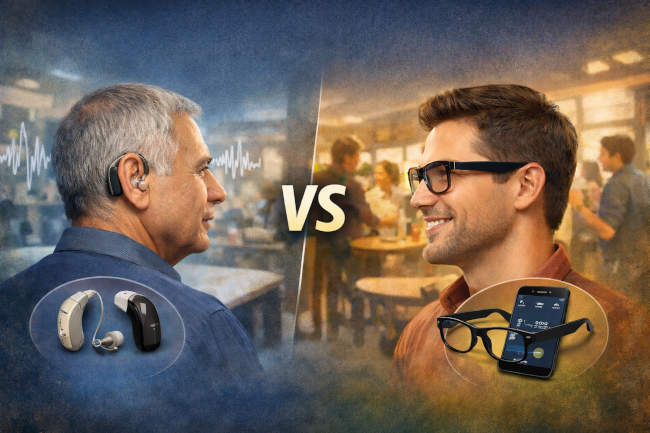
Hearing support is starting to look different from what many people expect. For a long time, the conversation centred almost entirely on traditional hearing aids: small devices worn in or behind the ear, built to make speech and everyday sound easier to follow. That is still the standard picture for a lot of people.
But newer products are starting to widen that picture. Hearing glasses are part of that shift. They combine eyewear with built-in audio support, which naturally leads to a big question: can they actually replace traditional hearing aids, or are they simply another option for a narrower group of people?
The honest answer is not yes or no across the board. It depends on the type of hearing loss, the person’s needs, and what they want from hearing support in daily life.
Understanding Hearing Loss and Traditional Hearing Aids
Hearing loss is not one single experience. Some people mainly struggle in noisy places. Others find group conversations tiring, miss parts of speech on the phone, or gradually notice that they keep turning the volume up more than everyone else wants. For some, the issue is mild and frustrating. For others, it is much more limiting.
Traditional hearing aids are still the main solution because they are designed specifically to amplify sound based on hearing needs. They come in several styles, including behind-the-ear and in-the-ear models, and they are widely used for mild through more significant hearing loss, depending on the device and fitting.
That is an important distinction. Traditional hearing aids, especially when fitted through hearing care professionals, still cover a wider range of hearing needs than newer lifestyle-led products do.
What Are Hearing Glasses?
Hearing glasses are designed to combine vision and hearing support in one wearable device. Instead of placing amplification directly in or behind the ear in the usual way, they build audio technology into eyeglass frames.
That makes the idea immediately appealing to some people. If you already wear glasses, combining both needs into one item can feel simpler and less intrusive. It also shifts hearing support into something that looks more like an everyday accessory than a medical device.
For adults with perceived mild to moderate hearing difficulty, Nuance Audio glasses offer a different kind of support. Instead of following the usual hearing-aid format, they build open-ear listening, background-noise reduction, app-based controls, and prescription-ready lens options into everyday eyewear. That makes them a more natural fit for some users, though not a full replacement for every kind of hearing aid.
Comparing Hearing Glasses and Traditional Hearing Aids
This is where the comparison gets more practical.
Traditional hearing aids are purpose-built hearing devices. Their entire job is to support hearing, and many models can be fitted or adjusted with much more precision. That makes them the stronger option for people with more than mild hearing difficulty, or for those who need more targeted support across a wide range of listening situations.
Hearing glasses are more of a hybrid. They may be especially appealing to adults with mild to moderate hearing difficulty who also like the idea of open-ear listening and a less clinical-looking device. They can make speech in noisy environments easier to follow while folding that support into something wearable and discreet.
But that does not automatically make them a full substitute. The real comparison is not “new versus old.” It is more about which tool fits which person.
Pros and Cons of Hearing Glasses
The appeal of hearing glasses is easy to understand.
One obvious advantage is discretion. For people who dislike the feel, look or stigma associated with traditional hearing aids, hearing glasses may feel like a more natural step. They can also reduce the number of separate devices a person wears each day, which is especially attractive for those who already rely on prescription glasses.
There is also the lifestyle side. A product like this can feel less medical and more integrated into normal routines. That matters, because one reason some people delay hearing support is not always denial. Sometimes it is simply that the available options do not feel like something they want to wear.
The drawbacks are just as important, though. Hearing glasses are not as universally suitable. They may be a poor fit for someone who does not wear glasses often, and they may not offer the same level of hearing support that a more traditional, purpose-built hearing aid can provide for more advanced hearing loss. They also tie hearing support to eyewear, which can be convenient for some people and limiting for others.
In other words, the strengths are real, but so are the boundaries.
The Future of Hearing Assistance Technology
What hearing glasses really show is where hearing support may be heading: toward products that feel more wearable, less clinical, and more blended into everyday life.
That does not mean traditional hearing aids are disappearing. It means the category around hearing assistance is expanding. Some people will still need the range, tuning, and flexibility of conventional hearing aids. Others may be well served by newer solutions that feel simpler and easier to adopt.
For many people, that may be the most meaningful change. Not that one device replaces all the others, but that hearing support starts to feel less narrow and more personal.
Conclusion
So, can hearing glasses replace traditional hearing aids?
For some adults with mild to moderate hearing difficulty, they may be a realistic alternative. They can offer a more discreet, lifestyle-friendly way to support hearing, especially for people who already wear glasses and want something less conventional.
But they are not a universal replacement. Traditional hearing aids still play a much bigger role for people who need more tailored support or who have hearing loss beyond the mild to moderate range. In that sense, hearing glasses are best understood not as the end of traditional hearing aids, but as part of a broader shift in how hearing help is delivered.
That is what makes them interesting. They are not trying to do everything for everyone. They are opening the door for more people to find a type of hearing support that actually fits their lives.




Speak Your Mind